Saturday, July 14, 2012

Sanskrit aṅga अङ्ग not a "limb"


Monier-Williams' dictionary, p.7
 In most of our dictionaries, we find that the Sanskrit word aṅga अङ्ग means "limb, member."  "A limb of the body" says MW, following his teacher Wilson.
As a result, when we have expressions like aṣṭāṅgayoga अष्टाङ्गयोग or aṣṭāṅgavidyā अष्टाङ्गविद्या, we commonly get translations like, "yoga of eight limbs" or "the science with eight limbs (medicine)."
If you open the bonnet (US hood) of your car, you see an engine with ... what?  Limbs?  I don't think so.  I think you see components, or parts.  A textbook is divided into, what, limbs?  No, sections, or parts. 

H. H. Wilson's dictionary, p.9

I'd love to see translators of the word aṅga  अङ्ग try harder, and offer some inner resistance to the dead hand of our nineteenth-century dictionaries.  It's as if a mass of [dictionary] words falls upon the facts like soft snow, blurring the outline and covering up all the details (with sincerest apologies to Orwell.)
Next time you see aṣṭāṅgayoga अष्टाङ्गयोग, allow yourself to think instead, "the yoga with eight components." Or when you see aṣṭāṅgavidyā अष्टाङ्गविद्या, think, perhaps, "the science with eight parts."  If you see vedāṅga  वेदाङ्ग translated as "limb of the Veda," you can be sure that the translator isn't seeing the metaphors s/he's using.  What on earth would a "limb of the Veda" possibly be?  All the original author is saying is that the Veda has components or adjunct parts.  And don't let yourself use "ancilliary" either.  When did you last see that in a contemporary English novel?  In my dictionary, it's flagged as "very rare."
Too often, we indologists write and translate in mental companionship with our predecessors from the nineteenth century, and we write for colleagues who too often do the same. 
If you find yourself writing "limb" for aṅga अङ्ग, snap out of it.
Here I am, with Orwell, jeering loudly at worn-out and useless dictionary-bound translations.

Update 

For an argument in favour of "auxiliary" or "subsidiary" see S. Vasudeva (2004) The Yoga of the Mālinīvijayottaratantra (Pondicherry), p. 367, n. 1:


Saturday, July 07, 2012

Iamus and Intentionality

In the article "Iamus, classical music's computer composer, live from Malaga" (in the Online Guardian), Philip Ball describes the computer program Iamus that is emerging as a disturbing presence in the field of modern classical music. While discussing how we seek for authorial meaning and significance music, he asks,
How does a performer interpret these pieces, given that there's no "intention" of the composer to look for? "Suppose I found a score in a library without knowing who wrote it," says Díaz-Jerez. "I approach these pieces as I would that one – by analysing the score to see how it works." In that respect, he sees no difference from deducing the structure of a Bach fugue.

You can compare it with computer chess, says the philosopher of music Stephen Davies, of the University of Auckland in New Zealand. "People said computers wouldn't be able to show the same original thinking, as opposed to crunching random calculations. But now it's hard to see the difference between people and computers with respect to creativity in chess. Music, too, is rule-governed in a way that should make it easily simulated."
This reminds me strongly of the discussion that took place amongst Mīmāṃsaka philosophers in India about the possibility of a injunctive force being exerted by a scripture having no author and therefore no inherent intentionality (see, e.g., John Taber on this topic).

What would a Mīmāṃsaka say about computer-generated music?  Or computer-generated scripture, for that matter?

And can you tell human- and computer-generated music apart?  Take this test :-)

Thursday, July 05, 2012

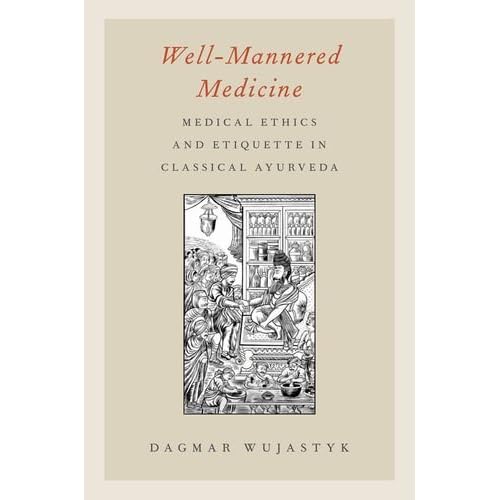
Well-mannered Medicine published

I'm ever so proud about the publication this month of Dagmar's new book, Well-Mannered Medicine: Medical Ethics and Etiquette in Classical Ayurveda.

Please note that there are now two different "D. Wujastyk"s publishing on the history of science and medicine in South Asia. :-)

Here's the blurb:
Well-Mannered Medicine explores the moral discourses on the practice of medicine in the foundational texts of Ayurveda.

The classical ayurvedic treatises were composed in Sanskrit between the first and the seventh centuries CE, and later works, dating into the sixteenth century CE, are still considered strongly authoritative.  As Wujastyk shows, these works testify to an elaborate system of medical ethics and etiquette. Physicians looked to the ayurvedic treatises for a guide to professional conduct. Ayurvedic discourses on good medical practice depict the physician as highly-educated, skilled, moral, and well-mannered. The rules of conduct positioned physicians within mainstream society and characterized medical practice as a trustworthy and socially acceptable profession. At the same time, professional success was largely based on a particular physician's ability to cure his patients. This resulted in tension, as some treatments and medications were considered socially or religiously unacceptable. Doctors needed to treat their patients successfully while ostensibly following the rules of acceptable behavior.
Wujastyk offers insight into the many unorthodox methods of avoiding conflict while ensuring patient compliance shown in the ayurvedic treatises, giving a disarmingly candid perspective on the realities of medical practice and its crucial role in a profoundly well-mannered society.

Editorial Reviews

"Dagmar Wujastyk's thorough study of medical ethics in classical Ayurvedic texts adds substantially to our knowledge of Ayurveda as a medical system. Ethics here includes the moral attributes required of a physician, personal presentation, medical education, the doctor-patient relationship, medical deception, and much more. In this first rate study, Wujastyk avoids the danger of evaluating Ayurveda from the standpoint of Western medicine. This is required reading for everyone with an interest in Indian medicine or cross-cultural medical history."--Frederick M. Smith, Professor of Sanskrit and Classical Indian Religions, University of Iowa

About the Author

Dagmar Wujastyk is a postdoctoral research fellow at Zurich University in Switzerland and co-editor of Modern and Global Ayurveda - Pluralism and Paradigms. She has taught Sanskrit at the University of Bonn and Cambridge University.

Tuesday, July 03, 2012

Sanskrit hyphenation list

I'm gradually building up a file of hyphenated Sanskrit words and compounds, written in the Latin alphabet.  The file is called sanskrit-hyphenations.tex, and you are welcome to download it.

It contains hyphenation points for words in English (ayur-veda), and for words in Sanskrit (āyur-veda).
 To use it, do something like this in your style file:
\setotherlanguage{sanskrit}
\newfontfamily\sanskritfont{Sanskrit 2003}
% Define \sansk{} which is the same as \emph{}, except
% that it causes appropriate hyphenation

% for Sanskrit words.  Use \sansk{} for Sanskrit and
% \emph{} for English.

\newcommand{\sansk}[1]{\emph{\textsanskrit{#1}}}
 and \input the sanskrit-hyphenations.tex file after \begin{document}, thus:
\begin{document}
  \input{sanskrit-hyphenations.tex}

...
\end{document}

XeTeX  already has built-in hyphenation rules for Devanāgarī and Romanized Sanskrit. The above file is intended to extend the hyphenation coverage for Romanized words, using etymological and stylistic considerations.

Friday, June 22, 2012

(Deep breath) Medical history again

The story so far

My three previous blogs on this topic are, in chronological order,  1 here, 2 here, and 3 here.
(All my blogs on the topic of the journal Medical History are collected here.)


  1. In the first post, I sketched the history of this important journal and expressed regret about the journal's move from the Free-to-read, Open Access, author's copyright model to a pay-to-read, closed access, publisher's copyright model. 

    The journal's new editor, Sanjoy Bhattacharya, responded here, defending the new policies.
  2. I responded here, noting that the new website was inconsistent, and that there were unsolved contradictions about payment structures, and that in no case did the publisher offer the author the option of retaining copyright.
  3. When the first new issue appeared in January 2012, I noted that articles were freely downloadable and authors were ascribed copyright. This was very good for the authors and readers, but some contradictory information about rights and payments continued to be present on the publisher's website. 

And now...

No abstract
The April 2012 issue of Medical History is out.  I'm sorry indeed to see that things have changed for both this issue and the previous January one.  The freedoms that were earlier present in the January issue have been revoked.  The statements giving authors copyright have been removed.  Articles are not freely downloadable.

No way to read the article...
Most bizarre of all, no articles are now readable at all.  Even at a price.  The website give abstracts for most - but not all - articles (see above right).  But that's all.  Even if you have an account with the CUP journals site, and log in, you still cannot read any articles in Medical History.
You can link to them, you can refer to them, you can link, blog and write to the author.  You can request permissions, e.g., to reprint or copy the article.  You can do most things, except reading the articles (see left).

This surely has to be a temporary glitch?

If you are logging in from an institutional licensee, such as a university network, then yes, you can download the PDFs.  But if you do not have such an affiliation, then you cannot download any article.

No downloads at PMC
I thought that perhaps the articles were now at Pub Med Central (PMC), as Sanjoy had said they would be, and that readers were meant to know this and read the articles from there.  But that's not the case either.  Neither of the new issues has appeared at PMC (see right).  It was always understood that there would be a time-lag before articles appeared at PMC, and the journal is starting again from zero, administratively speaking, so perhaps it's just a matter of patience before the freely-downloadable version of the articles appear.

Subscription prices
However, as long as an individual cannot download the articles at all from anywhere, I suppose the only way to read the journal is to order a printed copy.  But one can only buy the printed journal if one is an organisation (left).  So for anyone who doesn't have access to an institutional licence, access to Medical History is limited or impossible.

Back issues

And, confusingly, CUP is offering to sell rights to consult the past archive, that the Wellcome Trust has paid for already to be freely available at PMC: "... access to the digitised archive must be purchased separately. Please email [so-and-so] for a tailored package quote." This again must be a glitch.

In general, it looks as if CUP is trying to fit Medical History into a Procrustean bed designed for its other more commercial offerings.

On CUP's MH website under "back issues / digitised archive," selected past issues of MH are now displayed (see right).  But once again, there is no button for actually downloading a PDF for any of the articles.  Nor is there any link to PMC, where whole journal from 1957-2011 is already available free.

New Open Access Policy

I think the terms of the Open Access agreement for Medical History have changed since I last looked at them.  I don't remember seeig the following statement:
If you choose to publish your article in this way [Open Access] you are required to complete the following form, within one week of your
manuscript being accepted for publication by Medical History. If you prefer not to take part in the Open Access option,
you need not do anything; your article will be published in the usual way, with access to the complete text being available only
to subscribers
. [my bold]
The corresponding author should complete this form, and by doing so he or she authorises that the full charge of £425/$675,
plus VAT where applicable, will be paid.
CUP will NOT grant Open Access to your article unless you pay them $675.  This statement raises serious questions about whether all articles will continue to appear in PMC, as asserted by Sanjoy and as desired by the Wellcome Trust.

Summary

So, where do things stand now?
  1. Authors don't have copyright, in any model of publication in MH.
  2. Articles are not freely downloadable.
  3. Articles cannot be downloaded at all by private persons, even for purchase.
  4. Private persons apparently cannot buy the print version of journal issues.
  5. CUP wants to charge for access to past archived issues of the journal.
  6. No article will be available Open Access unless $675 is paid by the author.
I still hope that some of these issues are just teething problems.  I also hope that, as Sanjoy said, articles will appear as free downloads at the PMC site, in a "version of record," and that the current de facto embargo period of six months and growing is also just an initial administrative problem.

Between 2005 and 2011, Medical History was an Open Access journal that assigned copyright to individual authors, and charged no fee to authors or to readers.  The journal embraced all the best and most innovative models of the distribution of scholarly knowledge (see Open knowledge, Open definition, Open Access).   That model of publication has been abandoned, in favour of a closed-access, strongly commercialized system.  If all MH articles start to appear for free, full-text, version-of-record download at PMC, it will make a big difference.  But it remains hard to see how the commercial and copyright requirements of CUP can be squared with free distribution though PMC.

Friday, June 08, 2012

Xapian niceness

In older Linuxes, if xapian indexing is sucking up all your CPU cycles, here's a fix:
I believe this is long ago fixed in Ubuntu releases and doesn't need to be done manually.

Friday, June 01, 2012

Crowdsourcing manuscript transcription

The TEI world is discussing, amongst many things, the crowdsourcing of MS transcription.  This idea seems to hold great promise for the Indian case.  After all, we've got crowds, right?  As always, the issue is quality control.

But just for a moment, imagine the scenario of an open, public, collaborative website where anybody can bring up an image of a Sanskrit manuscript and write a transcription in an adjacent window.  A transcription that - like a Wikipedia article - would be open for others to improve or annotate, that would rely on crowdsourced cognitive surplus for contribution and gradual quality improvement.  It would be under a history/version control system, so everything would be trackable.  Contributors would earn trust points or, as in eBay's feedback score. 

Ben Brumfield has created an extremely useful survey of MS transcription tools here.

His own FromThePage service looks simple to use and very attractive for a proof-of-concept pilot project.

For example, the Transcribe Bentham project has developed this way of working:
See also the other video about markup, on their "getting started" page.

All the exciting work in MS and edition work today is happening in connection with the TEI framework, and based on transcribed MSS with TEI encoding.  Juxta, the Versioning Machine, etc.  We need to start thinking about creating a public, high-quality corpus of transcribed MSS.  Such a corpus would be the basis for many future projects.

See also:

-----

References

  • Clay Shirkey's Cognitive Surplus: Creativity and Generosity in a Connected Age (2011). And a TED talk on the same subject.
  • Transcribe Bentham project at UCL .

Thursday, May 24, 2012

Two more good Devanāgarī fonts

I have posted an update to this post with some new material.

Steve White has recently done a great deal of work updating the FreeSerif and FreeSans Unicode fonts (that are, er, free).   He has done especially important work on the Devanagari characters in the font, as well as several other Indian writing systems.  See here for a listing of what has changed. Steve's work means that the Devanāgarī in the Free* fonts now works not only with Xe(La)TeX but also in Firefox, LibreOffice and other programs.  Thanks, Steve!

Zdeněk Wagner recently announced (here) that,
A few days ago version 20120503 of GNU FreeFont was released. This (OpenType as well as TrueType) version contains working Devanagari. FreeSans is based on Gargi with bugs fixed and positions of matras fine-tuned (and changes were reported back to the Gargi developers), FreeSerif is based on Velthuis fonts. Both fonts contain the Indian Rupee sign. In XeLaTeX, conjuncts in FreeSerif can be switched on/off according to the language.
Zdeněk provided an example file showing FreeSans and FreeSerif, and demonstrating the different conjuncts of Sanskrit and Hindī.  I have taken the liberty of expanding his file to compare some of the other leading Unicode fonts that contain both Devanāgarī and Latin typefaces in the same font:

XeLaTeX Input:
\documentclass{article}
\usepackage{polyglossia}

\defaultfontfeatures{Mapping=RomDev,Script=Devanagari,Language=Sanskrit}
\newfontfamily\eng[Mapping=tex-text]{TeX Gyre Pagella}
\begin{document}
\setmainfont{FreeSerif} \newfontfamily\eng[Mapping=tex-text]{FreeSerif}
{\eng FreeSerif} = शक्ति, kārtsnyam {\addfontfeatures{Language=Hindi} Hindī = शक्ति}
\setmainfont{FreeSans} \newfontfamily\eng[Mapping=tex-text]{FreeSans}
{\eng FreeSans} = शक्ति, kārtsnyam {\addfontfeatures{Language=Hindi} Hindī = शक्ति}
\setmainfont{Sanskrit 2003} \newfontfamily\eng[Mapping=tex-text]{Sanskrit 2003}
{\eng Sanskrit 2003} = शक्ति, kārtsnyam {\addfontfeatures{Language=Hindi} Hindī = शक्ति}
\setmainfont[FakeStretch=1.08]{Sanskrit 2003}
{\eng Sanskrit 2003+} = शक्ति, kārtsnyam {\addfontfeatures{Language=Hindi} Hindī = शक्ति}
\setmainfont{Nakula} \newfontfamily\eng[Mapping=tex-text]{Nakula}
{\eng Nakula} = शक्ति, kārtsnyam {\addfontfeatures{Language=Hindi} Hindī = शक्ति}
\setmainfont{Sahadeva} \newfontfamily\eng[Mapping=tex-text]{Sahadeva}
{\eng Sahadeva} = शक्ति, kārtsnyam {\addfontfeatures{Language=Hindi} Hindī = शक्ति}
\end{document}
Output:
(click to enlarge)

Note the use of the RomDev mapping to get "कार्त्स्न्यम्" out of "kārtsnyam", just for fun.  I've included Sanskrit 2003 twice, the second time with a bit of horizontal stretch, that I think makes it look nicer.
The official web page of the newly-updated FreeSans and FreeSerif fonts is:
As Zdeněk adds, ``Hopefully the font will soon appear in TeX Live and (some) Linux distributions. If you install it independently, be sure that you do not have font conflicts."

Be sure to delete all earlier versions of FreeSerif and FreeSans that might be lurking on your hard drive.  Then install the new version.  If you find the conjuncts aren't working as promised, you probably have an old FreeSerif or Sans lurking in a directory somewhere that you have forgotten about.

Saturday, May 19, 2012

Medical History (cont.)

The January 2012 issue of the journal Medical History has now appeared online (here).  This is the first issue with the new publishers and under the new editorship.

The good news is that
  • the articles are copyrighted to the authors, and
  • articles are freely downloadable.  
This is very good for the authors and readers.  However, the terms on which the papers may be distributed are not stated.  The authors may not wish their papers to be copied, or they may wish to charge for copies, or they may wish to apply one of the several Creative Commons licenses.  Nothing is stated.  However, since the PDFs of the papers are freely downloadable from the CUP website, obviously this is what the authors and the publisher intend readers to do.

If you click the "Request Permissions" on the CUP website, then a window opens in which CUP asserts its own copyright of the article.

A menu system lets you request various things, including the right to make photocopies not-for-profit.  The charge for this right (not the copies themselves) is about $5 per copy.  This charging option appears to be an honour system.

The Transfer of Copyright form is still presented for authors to sign (here), by which authors sign over their copyright to CUP.  But since authors seem to be keeping their copyright (a very good thing) perhaps these forms are just a relic, and will be withdrawn.

The same applies to the Open Access Transfer of Copyright form (here), which asks authors to send CUP £425/$675 (plus VAT) for giving their copyright to CUP and having CUP publish their articles under an Open Access license.  Perhaps if one paid this fee, the "Request Permissions" page would not ask for money for photocopies?  In any case, since everyone can download the articles freely already, and they are copyrighted to the authors, there would seem to be little incentive to pay the above fee.  The authors - who own the copyright - could themselves choose to place a Creative Commons license on their work, for example an Attribution-NoCommercial-NoDerivs license, thereby releasing any reader from the obligation to pay anything for making copies or using the article in teaching, linking to it from a Moodle website, etc.

So, at present, the rights and distribution situation with Medical History shows real promise.  Authors are retaining their copyright, and articles are freely downloadable from the CUP website.  This is great   In due course, presumably the articles will also appear in the online Medical History archive at the National Library of Medicine / Pub Med Central (here), as the editor, Sanjoy Bhattacharya said they would.

Residual confusions exist because of the continuing statements on the journal's CUP website that CUP owns the copyright of the articles, and that it wants authors to transfer their rights to CUP and to pay fees for Open Access distribution.  It is very much to be hoped that these are just teething problems and that the journal will continue to
  • allow authors to retain copyright 
  • that authors will not be charged any "article processing fee", and
  • that articles will be freely readable by anyone anywhere.