Monday, September 07, 2009
Wednesday, February 18, 2009
Monday, September 08, 2008
Ballantyne's 1855 edition of the Mahābhāṣya
I'm glad to have found Ballantyne's edition of the Mahābhāṣya with Kaiyaṭa and Nāgeśa's commentaries, in the Digital Library of India collection. The edition is from Mirzapore, 1855 (bibliographical details).
Here are some representative pages from it:

Title page:
Mahābhāṣyam
bhāṣyapradīpena vivaraṇena ca sahitaṃ
kāśyāṃ rājakīyapāṭhālaye śrīmadvālaṇṭainnāmaka-
***
śrīnārāyaṇaśāstridevadatta-
durgodattaśarmabhirvyākaraṇapaṇḍitaiḥ
śrīmaccaturvedahīrānandaśarmabhir
alaṅkārapaṇḍitaiś ca saṃśodhitaṃ
sāṃkhyaśāstrādhyāpakaśrīmatkāśīnāthaśāstribhir
nidhyātaṃ
***
mirjāpurapattane trivedidurbaliśarmaṇā saṃśodhya mudrākṣariar upanibaddhaṃ
bhāratavarṣīya-
paścimottarapradeśādhyakṣaniyogān mudritam
// san 1855 īsvī //
So now we know that Ballantyne was aided by Nārāyaṇaśāstrī [and?] Devadattadurgodattaśarmā, specialist(s) in vyākaraṇa, and with Caturveda Hīrānandaśarmā, an alaṅkāra paṇḍit. These pandits
edited the text. The sāṃkhya professor Kāśīnāthaśāstrī reflected upon the
text (nidhyātaṃ), which presumably means that he edited the text for content.

The text was edited and typeset in Mirjāpurapattana by Durbaliśarmā.
And here are the first two and the last pages of the text:


Friday, October 12, 2007
Yet again on Goldstücker's Mahābhāṣya editions
A few weeks ago I went into Cambridge University Library and had a look at Goldstücker's editions of the Mahābhāṣya. The entry by Haas in the BL catalogue (see previous blog post) gives no sense of the sheer physical size of these publications. These are seriously big volumes. They filled all the shelves of a delivery trolley. They gave me a sense of some quixotic mission in Goldstücker's mind, that somehow reproducing these raw, unprocessed mss in London, at enormous cost, could achieve a socio-political end, could establish in Europe a renewed respect for India's intellectual traditions.
There are three publications here, each being an unadorned photocopy (in modern terms) of a Sanskrit manuscript in Devanāgarī script:
1. Patanjali's Mahābhāshya. Reproduced ... samvat, 1751. In one volume.
Patanjali's Mahābhāshya with Kaiyyaṭa's Bhāshyapradīpa ... from an undated manuscript. In three volumes.
3. Title page:
Nāgojibhaṭṭa's Bhāṣyapradīpoddyota on Kaiyyaṭa's Bhāshyapradīpa. Reproduced by photo-lithography under supervision of Professor T. H. Goldstücker from a manuscript dated samvat, 1871. In two volumes. London: India Museum 1874. (Camb. UL. S833.a.87.6)
There are three publications here, each being an unadorned photocopy (in modern terms) of a Sanskrit manuscript in Devanāgarī script:
- Mbh. 1 vol.
- Mbh with Kaiyyaṭa. 3 vols.
- Mbh with Kaiyyaṭa and Nāgeśa. 2 vols.
1. Patanjali's Mahābhāshya. Reproduced ... samvat, 1751. In one volume.
The first 20 ff. of this ms. (pp. 2-41) are from a different ms. than the remainder. Ends: iti ata parāṇivo yathānyāsam iti kaścātra ... ukāraśca na tau staḥ yad iha tau syātāṃ//2. Title page:
p.43, scribe's fol. 8r,: tāv evāyam upadiśet nanu
It's a lovely Jaina ms, magnificently written.
Ends, v.2, p.697: saṃvat 1751 varṣe poṣaśukla trayodaśyāṃ tithau vudhāvasare śrīsarasāmadhye likhitā pratiriyaṃ ṣrī kharataragacche śrīśrī ṣagaracaṃdrasūrisāṣāyāṃ vācanācārya śrīsukhani?dhāna?gaṇīnāṃ tacchiṣyavācanācārya ... āṇaṃdadhīra likhitaṃ ... ṣrījinadattasūri jnnakuśalasūriprasādāt/
Patanjali's Mahābhāshya with Kaiyyaṭa's Bhāshyapradīpa ... from an undated manuscript. In three volumes.
Vol.3, p.2218 has post-colophon:
kāṣyāṃ gṛhītaṃ makarasthe gurau saṃvat// iti mahābhāṣye aṣṭamo dhyāyaḥ// ṣrī rāhakaṣṇāya namostu// rāmamahābhāṣyasya pustakam idam āhnika 7
Nāgojibhaṭṭa's Bhāṣyapradīpoddyota on Kaiyyaṭa's Bhāshyapradīpa. Reproduced by photo-lithography under supervision of Professor T. H. Goldstücker from a manuscript dated samvat, 1871. In two volumes. London: India Museum 1874. (Camb. UL. S833.a.87.6)
This is a ms. of saṃ 1811, sāke 1676 [AD 1754] vakratuṇḍasamīpe, manikarṇikāghāt, kāśī, copied by Udaigaja kāyastha.Therefore, it looks as if G. may have misread 1811 as 1871. Or perhaps the printers who prepared the t.p. (after G. had died) made the mistake.
Wednesday, August 29, 2007
Dānasāgara fo Ballālasena on text criticism.


The Dānasāgara of Ballālasena (ca. 1200) includes a number of interesting and important remarks on the nature of Sanskrit scholarship, methods of teaching and learning, the creation of manuscripts and their donation to temples, etc. The displayed passage describes textual criticism (ed. B. Bhattacharya, 1953, Bibliotheca Indica 274, pp.४८०-८१).
Monday, August 13, 2007
More on early editions of the Mahābhāṣya
 The 1876 Catalogue of Sanskrit and Pali Books in the British Museum, by Haas, p.100, contains the entries on the right for Mahābhāṣya editions:
Thus, there was the beginning of an edition by Ballantyne in 1855-1856, which is very early. Although this is only a small part of the whole text, the Navāhnika is a seminally important part of the work. It is interesting to see that even in this very early edition, the commentary of Kaiyaṭa and the subcommentary of Nāgeśa are included. Ballantyne usually worked in close collaboration with paṇḍits, whom he was generous in acknowledging. I will be interesting to know with whom he produced this edition.
Then there's an edition fifteen years later, in Varanasi in 1870. This looks like a real "paṇḍit's" edition, also with the important commentary of Kaiyaṭa but with only notes from the editors and from Nāgeśa and by the paṇḍits themselves. Its production, just over a century after Nāgeśa Bhaṭṭa's death, and in his home town, is likely to embody at least to some extent a direct lineage of the interpretation of the text from the great Varanasi grammarians of earlier times, including Vaidyanātha Payaguṇḍa, Nāgeśa and Bhaṭṭoji Dikṣita.
 And then the 1876 Haas catalogue gives the entry on the left, which refers to the lithograph discussed in my post of October 16, 2007, about the lithographer William Griggs and the shockingly expensive lithograph he produced. Haas has identified or corrected the date of the manuscript (saṃ 1751 = AD 1808/9). I have not seen the edition yet, but I would hazard that the manuscript is part of the old IOLR collection in the BL. This lithograph was published in London in 1874, in a limited edition of 50 copies. There's this copy in the British Library, and I would expect to find copies in Oxford and Cambridge at least.
So now we know that the impulse behind this old lithographic edition came from Theodore Goldstücker (1821-1872), who was at that time a professor at University College London, having been invited to move from Germany to England by H. H. Wilson in 1850. Goldstücker was a "Forty-Eighter" in the sense of being a refugee from the German Revolution of 1848-1849. This lithograph edition of the Mahābhāṣya was published posthumously.
It would seem, though, that even at the time of its publication, the London edition has already been partially superseded by the Varanasi edition of four years earlier. However, the London edition provided the whole of Nāgeśa's subcommentary, where the Varanasi edition only gave extracted notes, so it certainly pushed the boundary of knowledge forward.
Goldstücker had earlier written a book about Pāṇinian grammar that was important and impressively penetrating for its time. The title of the 1861 edition of the book in the BL online catalogue is Panini, his place in Sanscrit Literature ... A separate impression of the preface to the Fac-Simile of MS. No. 17 in the Library of Her Majesty’s Home Government for India, etc. (BL classmark 14092.cc.4.). The text had first appeared as a preface to his edition of the Mānava-kalpa-sūtra, and was only published as a separate book in 1861. It was reprinted in Allahabad in 1914, Benares 1965, and may still be reprinted occasionally in India.
The excellent entry on Goldstücker in the DNB written by Nick Allen (doi:10.1093/ref:odnb/10925) throws valuable light on the interaction between Goldstücker's personality and his scholarship. He had a private income, and never drew a full salary from any university. Goldstücker functioned on the pattern of an eighteenth-century enlightenment gentleman scholar, in Steve Shapin's sense (A Social History of Truth), free from the prejudicial taint of employment and thus able to pursue truth impartially. He was very clever, very talented, and very hard-working. But his ambitions for scholarly achievement were so high that he judged much of his own writing to be unready for actual publication. Although kind and friendly on a personal level, he engaged in severe, even savage, criticism of other published Western scholars, but published little of his own work. Several of his books, including the Mahābhāṣya edition, were in fact facsimile or typeset reproductions of Indian scholastic manuscripts. In his introduction to one such edition, of the Jaiminīyanyāyamālāvistara by Mādhava, Goldstücker lays out his intention to publish a European equivalent of the famous Bibliotheca Indica series, with a special mission of publishing the manuscripts of the Colebrooke collection in the British Museum and, if possible, manuscripts from the Sarasvati Mahal library in Thanjavur that would be brought from Thanjavur to London by His Serene Highness Prince Frederic of Schleswig-Holstein, who was a Sanskritist.
As Allen notes, "For so learned a scholar Goldstücker's output was disappointing, and exercised only limited influence." Several of his main research projects ballooned in size and detail out of all proportion, becoming entirely unwieldy and impossible to complete or to publish. Thus he left a trail of unfinished works behind him. Two volumes of his minor articles and lectures were published posthumously in London in 1879. His papers were deposited in the British Museum, with a stipulation that they would not be published until after 1920, but by that time the Great War and subsequent scholarly progress and shifts in perspective meant that his works would no longer be viewed as worth the labour of editing and publication. As Allen further noted, "Critics have also said that, for all his zeal and fastidiousness, he lacked sound judgement, and was insufficiently critical of native Indian scholarly tradition." Golstücker held enormous admiration for the tradition of Sanskrit scholarship in India, and believed that Indian culture and society would gain immeasurably through the recovery of its ancient intellectual achievements, and that this was most appropriately achieved through a synthesis of Indian and European scholarly effort. Yet his own efforts to achieve his goals and to advance Sanskrit scholarship were, finally, Quixotic: grandiose, severe, and ultimately vain when compared with his undoubted talents.
Monday, July 30, 2007
Critical edition typesetting
Some years ago, John Lavagnino and I wrote the EDMAC
software for typesetting critical editions. EDMAC was an application for use with plain TeX. Later, adaptations were made to allow EDMAC to work with LaTeX etc. (LEDMAC).
In the early 2000s, the ConTeXt package, also based on TeX, started developing methods for handling critical edition typesetting. Idris Hamid, Colorado State University, gave this talk at the TUG 2007 conference, San Diego, about doing critical editions using ConTeXt. [Update, 2026-02: now see this 2007 talk.]
Friday, July 13, 2007
Ayurvedic Man

The famous "Ayurvedic Man" image (Wellcome Library Iconographic Collection 574912i) that has appeared on several book covers and in several publications, is owned by the Wellcome Library, London, and a low-res version can be viewed on their website. I wrote a small article referring to the image recently, in the journal Medical History.
As a result of a recent query about the texts that surround the image, I can now report that the texts are citations from the Bhāvaprakāśa of Bhāvamiśra, the 16th century physician who lived in North India, perhaps Varanasi. For more information on Bhāvamiśra, see G. J. Meulenbeld, Indian Medical Literature, IIa: 239--46.
The Bhāvaprakāśa texts cited in this painting almost all come from BhP 1.1. prakaraṇa 3 (garbhaprakaraṇa).
Monday, October 16, 2006
Earliest edition of the Mahābhāṣya?
William Griggs (1832–1911) was the inventor of a photolithographic process. The DNB entry on him has the following extraordinary information:
Griggs was as successful in bringing down the price of reproducing old manuscripts and letterpress texts as he had been in reducing costs in chromolithography. His production of fifty copies of the Mahabhasya (the standard authority on Sanskrit grammar), consisting of 4674 pages (1871), was carried out for £6000 less than the estimate for a tracing of the original manuscript by hand, an enormous sum at the time. More widely known were his Shakespeare quartos, with critical introductions by Frederick James Furnivall and others, in forty-three volumes (1881–91); hand-traced facsimiles of the same works by E. W. Ashbee, superintended by James Orchard Halliwell-Phillipps, had been sold at more than eight times the price.I was unaware of this piece of printing history, and it would be interesting to find out who commissioned this particular work, and to see copies of the photolithograph. It seems implausible that it would have cost much more than £6000 to commission scribes to copy out the Mahābhāṣya in the late 19 century. Griggs worked in London, in close association with the India Office.
Saturday, October 07, 2006
... on the history of Indian food
Oh, on the subject of the history of Indian food, one mustn't forget the rather wonderful publications of K. T. Achaya.
Friday, September 29, 2006
Amar Singh, Maharaja of Kanota and his cooking diaries
Amar Singh, the Maharaja of Kanota, near Jaipur,
has been the subject of a study by the Rudolphs: Reversing the
Gaze: Amar Singh's Diary, A Colonial Subject's Narrative of
Imperial India. Edited and Commentary by Susanne Hoeber
Rudolph and Lloyd I. Rudolph with Mohan Singh Kanota.
Boulder: Westview, 2002 (good review by Michael Fisher).
Amar Singh's diaries, covering 1898-1905, are about 89 vols,
each with 800 pages. I think Amar Singh was probably a little
eccentric. His diaries are very, very detailed, and not always
interesting. Except, of course, that in the mass of detail, there
are inevitably nuggets. He was a prominent and even eminent
military man, so one finds details of his meetings with
important players of the time, though what he writes about
them often extends only to what colour gloves they wore, or
which side of the carriage they got out.
Anyhow, I discovered this diary many years ago, through
accidentally meeting Mohan Singh Kanota (I stayed at the
Narain Niwas hotel in Jaipur, must have been in the 1980s),
and being taken out to Kanota to see the old man's library.
Although the Rudolphs have focussed on the diaries, it is
less well known that Amar Singh was also a passionate cook.
Or, perhaps, "supervisor of cooking" (as he was a supervisor
of photography also). His favourite hobby was to sit on the
veranda in the evening and direct a team of cooks in making
up dishes using recipes from classical sources. He drew on
many culinary traditions, including those recorded in Persian
and Sanskrit. Predictably, he wrote everything down. So along
one wall in the family home in Kanota there are many metres
of Amar Singh's cooking diaries. It is multilingual, with
text in Persian, Hindi, and Sanskrit. Possibly English, I
can't remember.
I am not aware that anyone has written about Amar Singh's
cookery diaries. His ordinary diaries have been microfilmed
and are on deposit at the University of Chicago library. I
don't know whether the cookery diaries were also filmed;
probably not.
This leads me on to mention the classical tradition of Indian
cookery, Skt. pākaśāstra पाकशास्त्र("Cooking Science"). There's
not much written about this, with one exception. Meulenbeld
notes 34 of the texts on this subject in his History of
Indian Medical Literature, IIa, part 9.1 (pp.415-20), and
gives detailed accounts of the contents of several of them.
As Meulenbeld points out, "pāka पाक" means a "linctus", as well
as "cookery", so not all the works on pāka śāstra are
actually on "medical cookery"; some are on linctus formulae.
Works on cookery in the Pāka Śāstra tradition seem to date
from AD 1200 and perhaps earlier. One of the earliest is the
Pākadarpaṇa पाकदर्पण or Nalapāka नलपाक ascribed to King Nala. It's a
work in 760 verses divided into 11 chapters, intended to inform
the cooking in a royal kitchen.
has been the subject of a study by the Rudolphs: Reversing the
Gaze: Amar Singh's Diary, A Colonial Subject's Narrative of
Imperial India. Edited and Commentary by Susanne Hoeber
Rudolph and Lloyd I. Rudolph with Mohan Singh Kanota.
Boulder: Westview, 2002 (good review by Michael Fisher).
Amar Singh's diaries, covering 1898-1905, are about 89 vols,
each with 800 pages. I think Amar Singh was probably a little
eccentric. His diaries are very, very detailed, and not always
interesting. Except, of course, that in the mass of detail, there
are inevitably nuggets. He was a prominent and even eminent
military man, so one finds details of his meetings with
important players of the time, though what he writes about
them often extends only to what colour gloves they wore, or
which side of the carriage they got out.
Anyhow, I discovered this diary many years ago, through
accidentally meeting Mohan Singh Kanota (I stayed at the
Narain Niwas hotel in Jaipur, must have been in the 1980s),
and being taken out to Kanota to see the old man's library.
Although the Rudolphs have focussed on the diaries, it is
less well known that Amar Singh was also a passionate cook.
Or, perhaps, "supervisor of cooking" (as he was a supervisor
of photography also). His favourite hobby was to sit on the
veranda in the evening and direct a team of cooks in making
up dishes using recipes from classical sources. He drew on
many culinary traditions, including those recorded in Persian
and Sanskrit. Predictably, he wrote everything down. So along
one wall in the family home in Kanota there are many metres
of Amar Singh's cooking diaries. It is multilingual, with
text in Persian, Hindi, and Sanskrit. Possibly English, I
can't remember.
I am not aware that anyone has written about Amar Singh's
cookery diaries. His ordinary diaries have been microfilmed
and are on deposit at the University of Chicago library. I
don't know whether the cookery diaries were also filmed;
probably not.
This leads me on to mention the classical tradition of Indian
cookery, Skt. pākaśāstra पाकशास्त्र("Cooking Science"). There's
not much written about this, with one exception. Meulenbeld
notes 34 of the texts on this subject in his History of
Indian Medical Literature, IIa, part 9.1 (pp.415-20), and
gives detailed accounts of the contents of several of them.
As Meulenbeld points out, "pāka पाक" means a "linctus", as well
as "cookery", so not all the works on pāka śāstra are
actually on "medical cookery"; some are on linctus formulae.
Works on cookery in the Pāka Śāstra tradition seem to date
from AD 1200 and perhaps earlier. One of the earliest is the
Pākadarpaṇa पाकदर्पण or Nalapāka नलपाक ascribed to King Nala. It's a
work in 760 verses divided into 11 chapters, intended to inform
the cooking in a royal kitchen.
Tuesday, August 22, 2006
intratext.com
I've just discovered www.intratext.com. An interesting service. Already has some trs. of Sanskrit and Pali texts. Has the Skt text of the RV in ITRANS format. Thought-provoking. Should we all jump on board?
Tuesday, June 27, 2006
Isidore of Charax
I've been doing a bit of work on Isidore of Charax's Parthian Stations. Thinking out loud, really, about the actual route, and what kind of communications might have been possible between the Mediterranean/ME and Afghanistan/India in the centuries around the beginning of the Common Era.
See http://tinyurl.com/fffzz/
See http://tinyurl.com/fffzz/
Thursday, May 25, 2006
Appaya Dikshita and Nilakantha Dikshita
 Appaya Dikshita (b. ca.1520,
d. 1592) transfers his copy of the Devimahatmya to his grand nephew Nilakantha Dikshita (1580--ca. 1644), just before he passes away. This happened at Cidambaram.
The account of Appaya's deathbed transfer of his
cultural and spiritual heritage to the twelve-year-old Nilakantha is
given in the biographies of Nilakantha, the
Srinilakanthadhvaricaritam of Appaya, the
Sriappayadiksitendravijaya, both composed by Appaya's
nineteenth-century descendant Sivananda Yogindra. The former text
is translated and reprinted by Pierre-Sylvain Filliozat,
Oeuvres Po'etiques de Nilakantha Diksita I (1967), pp.7, 349. P-S Filliozat also
gives information from the latter text and other sources,
(ibid., 4).
My thanks to Yigal Bronner for drawing my attention to this image.
We're working to find out its source.

Govinda Dikshita and his wife Nagamba
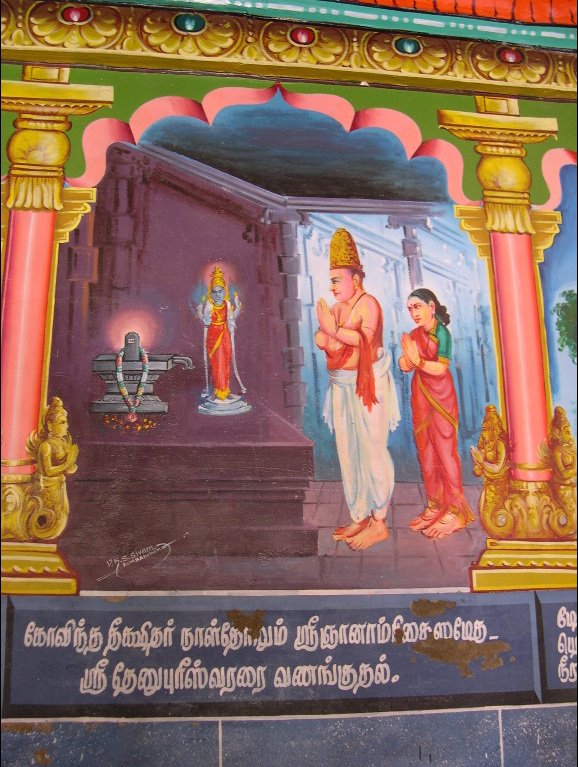
This painting of Govinda Dikshita and his wife Nagamba is on one of the walls of the Pattiswaram Temple, near Kumbakonam. It appears to be recent, or recently repainted. It is in a chamber not far from the statues of GD and N. Picture taken in 10/2005.
Sunday, April 16, 2006

V. M. C. Sankaran Nambudiri
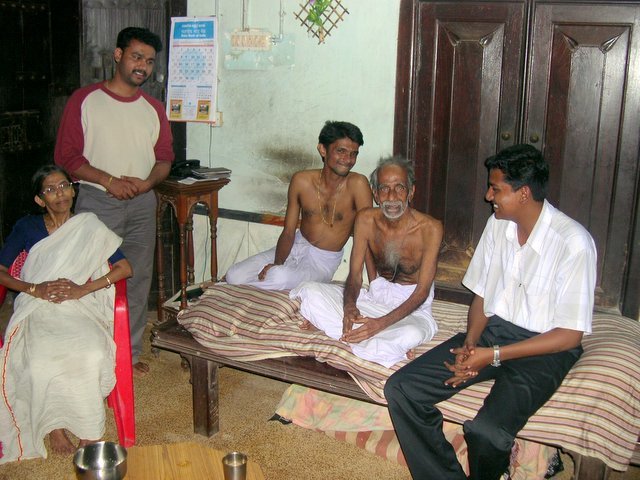 At the age of about 85 (in October 2005), V. M. C. Sankaran Nambudiri is one of the most respected teachers of ayurveda in Kerala today, and a great expert in Viṣavidyā. Pictured here at his home near Trissur, with his daughter and grandson Brahmadattan (on the bed behind him), and his pupils (Dr Madhu in the white shirt). See also the documentation at PADAM .
Agni, Pattiswaram Temple
 Agni, in current worship in the Pattiswaram temple, Kumbakonam district, S. India
Friday, April 14, 2006
Google Earth kmz file of some S Indian cultural centres
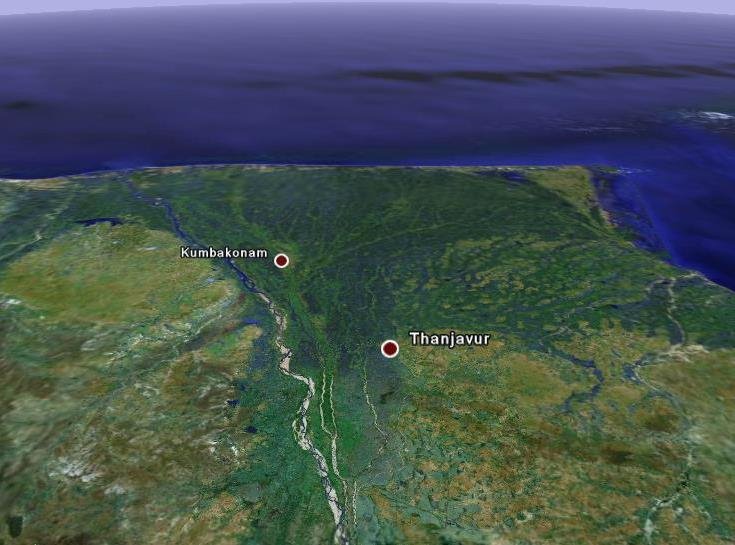
Here's a set of Google Earth data for some cultural centres near Kumbakonam and Thanjavur in southern Tamil Nadu:
Once you have Google Earth running with these place markers, click once on a marker for info (in some cases). Double-click to zoom in for a specific closeup and angle.
Enjoy!
DW
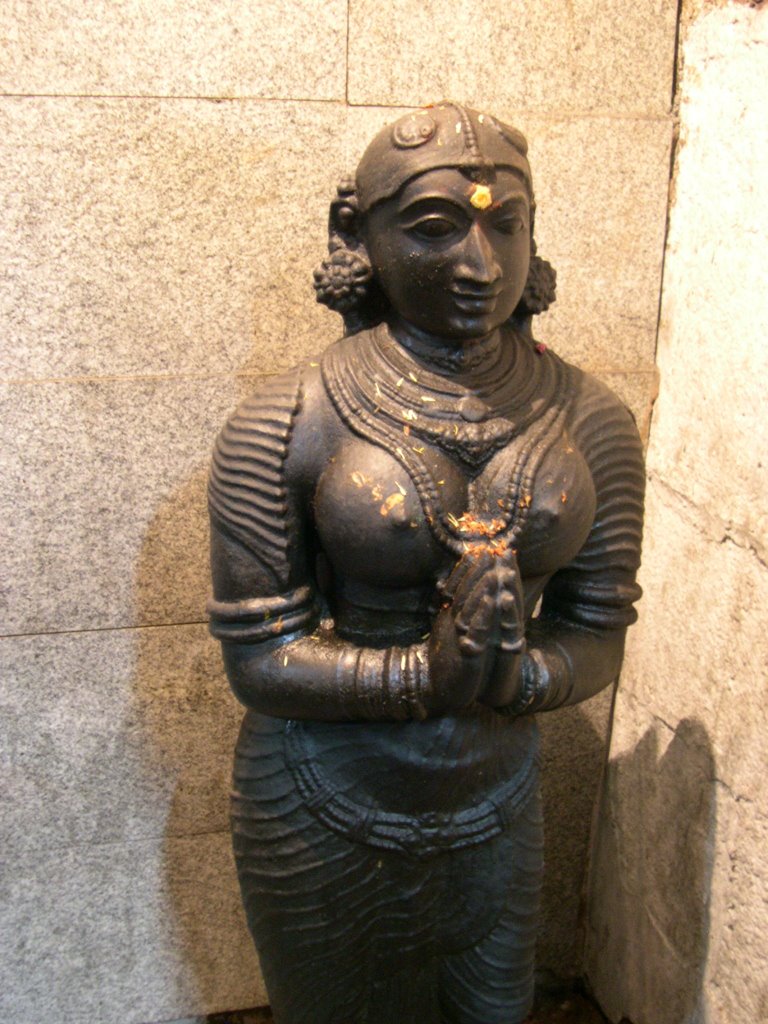 Nāgāmba, Govinda Dīkṣita's wife.
 Wrestling
 The gopuram from the first inner courtyard
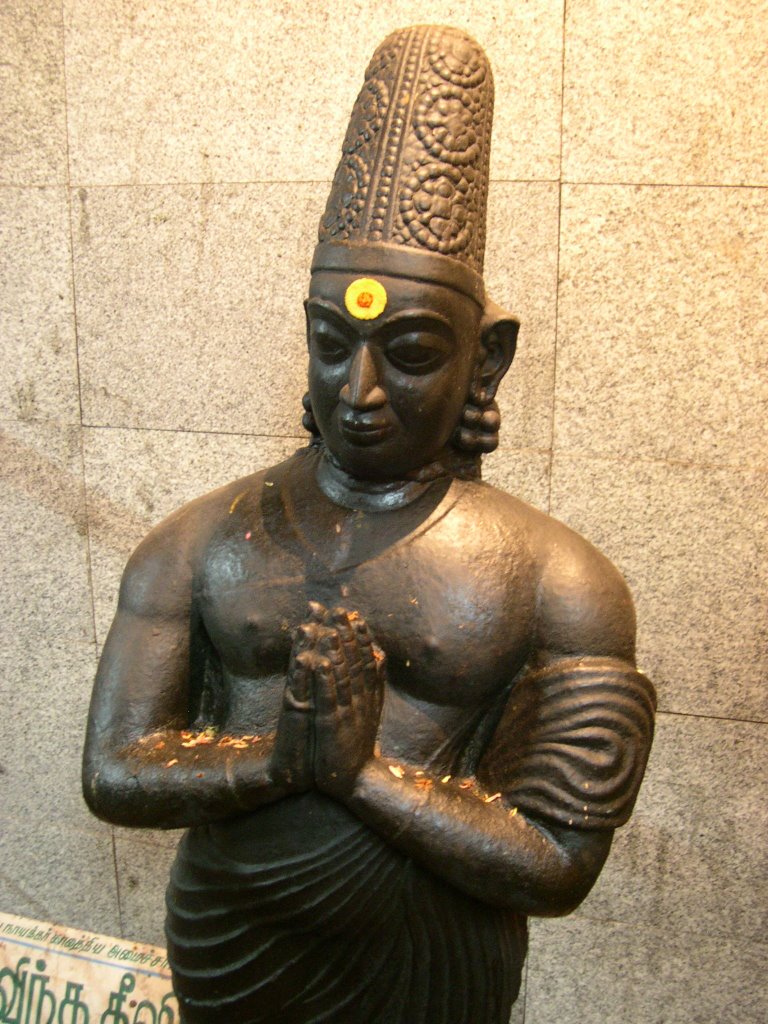 Govinda Dīkṣita, the great paṇḍit

Subscribe to:
Posts (Atom)