Monday, July 30, 2007

Critical edition typesetting

Some years ago, John Lavagnino and I wrote the EDMAC
software for typesetting critical editions. EDMAC was an application for use with plain TeX. Later, adaptations were made to allow EDMAC to work with LaTeX etc. (LEDMAC). 

In the early 2000s, the ConTeXt package, also based on TeX, started developing methods for handling critical edition typesetting.  Idris Hamid, Colorado State University, gave this talk at the TUG 2007 conference, San Diego, about doing critical editions using ConTeXt.  [Update, 2026-02: now see this 2007 talk.]

Friday, July 13, 2007

Ayurvedic Man


The famous "Ayurvedic Man" image (Wellcome Library Iconographic Collection 574912i) that has appeared on several book covers and in several publications, is owned by the Wellcome Library, London, and a low-res version can be viewed on their website. I wrote a small article referring to the image recently, in the journal Medical History.


As a result of a recent query about the texts that surround the image, I can now report that the texts are citations from the Bhāvaprakāśa of Bhāvamiśra, the 16th century physician who lived in North India, perhaps Varanasi. For more information on Bhāvamiśra, see G. J. Meulenbeld, Indian Medical Literature, IIa: 239--46.

The Bhāvaprakāśa texts cited in this painting almost all come from BhP 1.1. prakaraṇa 3 (garbhaprakaraṇa).


Monday, October 16, 2006

Earliest edition of the Mahābhāṣya?

William Griggs (1832–1911) was the inventor of a photolithographic process. The DNB entry on him has the following extraordinary information:

Griggs was as successful in bringing down the price of reproducing old manuscripts and letterpress texts as he had been in reducing costs in chromolithography. His production of fifty copies of the Mahabhasya (the standard authority on Sanskrit grammar), consisting of 4674 pages (1871), was carried out for £6000 less than the estimate for a tracing of the original manuscript by hand, an enormous sum at the time. More widely known were his Shakespeare quartos, with critical introductions by Frederick James Furnivall and others, in forty-three volumes (1881–91); hand-traced facsimiles of the same works by E. W. Ashbee, superintended by James Orchard Halliwell-Phillipps, had been sold at more than eight times the price.

I was unaware of this piece of printing history, and it would be interesting to find out who commissioned this particular work, and to see copies of the photolithograph. It seems implausible that it would have cost much more than £6000 to commission scribes to copy out the Mahābhāṣya in the late 19 century. Griggs worked in London, in close association with the India Office.

Saturday, October 07, 2006

... on the history of Indian food

Oh, on the subject of the history of Indian food, one mustn't forget the rather wonderful publications of K. T. Achaya.

Friday, September 29, 2006

Amar Singh, Maharaja of Kanota and his cooking diaries

Amar Singh, the Maharaja of Kanota, near Jaipur,
has been the subject of a study by the Rudolphs: Reversing the
Gaze: Amar Singh's Diary, A Colonial Subject's Narrative of
Imperial India. Edited and Commentary by Susanne Hoeber
Rudolph and Lloyd I. Rudolph with Mohan Singh Kanota.
Boulder: Westview, 2002 (good review by Michael Fisher).

Amar Singh's diaries, covering 1898-1905, are about 89 vols,
each with 800 pages. I think Amar Singh was probably a little
eccentric. His diaries are very, very detailed, and not always
interesting. Except, of course, that in the mass of detail, there
are inevitably nuggets. He was a prominent and even eminent
military man, so one finds details of his meetings with
important players of the time, though what he writes about
them often extends only to what colour gloves they wore, or
which side of the carriage they got out.

Anyhow, I discovered this diary many years ago, through
accidentally meeting Mohan Singh Kanota (I stayed at the
Narain Niwas hotel in Jaipur, must have been in the 1980s),
and being taken out to Kanota to see the old man's library.

Although the Rudolphs have focussed on the diaries, it is
less well known that Amar Singh was also a passionate cook.
Or, perhaps, "supervisor of cooking" (as he was a supervisor
of photography also). His favourite hobby was to sit on the
veranda in the evening and direct a team of cooks in making
up dishes using recipes from classical sources. He drew on
many culinary traditions, including those recorded in Persian
and Sanskrit. Predictably, he wrote everything down. So along
one wall in the family home in Kanota there are many metres
of Amar Singh's cooking diaries. It is multilingual, with
text in Persian, Hindi, and Sanskrit. Possibly English, I
can't remember.

I am not aware that anyone has written about Amar Singh's
cookery diaries. His ordinary diaries have been microfilmed
and are on deposit at the University of Chicago library. I
don't know whether the cookery diaries were also filmed;
probably not.

This leads me on to mention the classical tradition of Indian
cookery, Skt. pākaśāstra पाकशास्त्र("Cooking Science"). There's
not much written about this, with one exception. Meulenbeld
notes 34 of the texts on this subject in his History of
Indian Medical Literature, IIa, part 9.1 (pp.415-20), and
gives detailed accounts of the contents of several of them.

As Meulenbeld points out, "pāka पाक" means a "linctus", as well
as "cookery", so not all the works on pāka śāstra are
actually on "medical cookery"; some are on linctus formulae.

Works on cookery in the Pāka Śāstra tradition seem to date
from AD 1200 and perhaps earlier. One of the earliest is the
Pākadarpaṇa पाकदर्पण or Nalapāka नलपाक ascribed to King Nala. It's a
work in 760 verses divided into 11 chapters, intended to inform
the cooking in a royal kitchen.

Tuesday, August 22, 2006

intratext.com

I've just discovered www.intratext.com. An interesting service. Already has some trs. of Sanskrit and Pali texts. Has the Skt text of the RV in ITRANS format. Thought-provoking. Should we all jump on board?

Tuesday, June 27, 2006

Isidore of Charax

I've been doing a bit of work on Isidore of Charax's Parthian Stations. Thinking out loud, really, about the actual route, and what kind of communications might have been possible between the Mediterranean/ME and Afghanistan/India in the centuries around the beginning of the Common Era.

See http://tinyurl.com/fffzz/

Thursday, May 25, 2006

Appaya Dikshita and Nilakantha Dikshita

Appaya Dikshita (b. ca.1520,
d. 1592) transfers his copy of the Devimahatmya to his grand nephew Nilakantha Dikshita (1580--ca. 1644), just before he passes away. This happened at Cidambaram.

The account of Appaya's deathbed transfer of his
cultural and spiritual heritage to the twelve-year-old Nilakantha is
given in the biographies of Nilakantha, the
Srinilakanthadhvaricaritam of Appaya, the
Sriappayadiksitendravijaya, both composed by Appaya's
nineteenth-century descendant Sivananda Yogindra. The former text
is translated and reprinted by Pierre-Sylvain Filliozat,
Oeuvres Po'etiques de Nilakantha Diksita I (1967), pp.7, 349. P-S Filliozat also
gives information from the latter text and other sources,
(ibid., 4).

My thanks to Yigal Bronner for drawing my attention to this image.
We're working to find out its source. Posted by Picasa

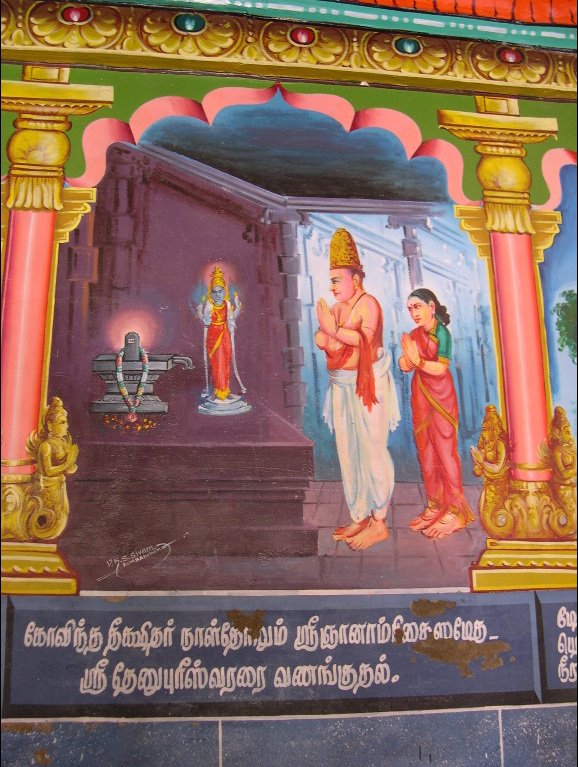
Govinda Dikshita and his wife Nagamba


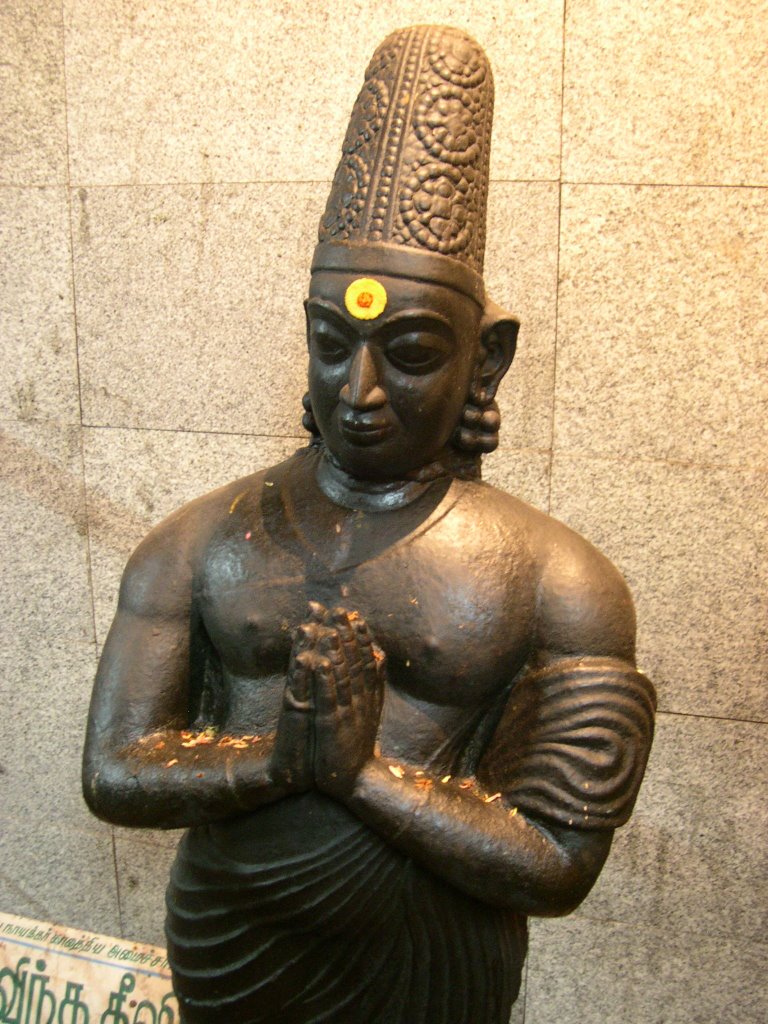
This painting of Govinda Dikshita and his wife Nagamba is on one of the walls of the Pattiswaram Temple, near Kumbakonam. It appears to be recent, or recently repainted. It is in a chamber not far from the statues of GD and N. Picture taken in 10/2005.

Sunday, April 16, 2006

N. S. Vayaskara Mooss

N. S. Vayaskara Mooss (1912-1986). Posted by Picasa

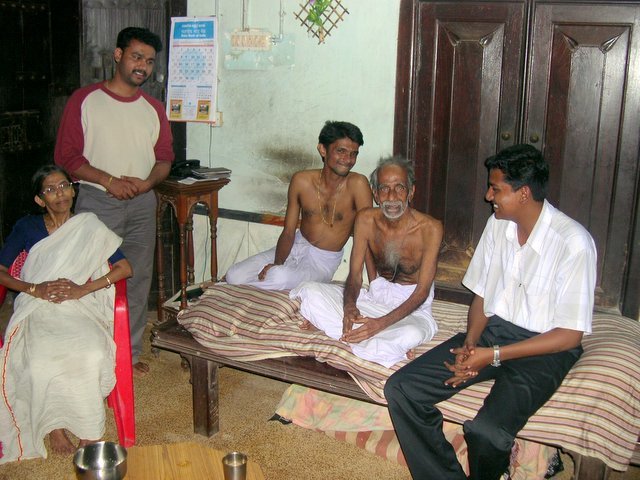
V. M. C. Sankaran Nambudiri


At the age of about 85 (in October 2005), V. M. C. Sankaran Nambudiri is one of the most respected teachers of ayurveda in Kerala today, and a great expert in Viṣavidyā. Pictured here at his home near Trissur, with his daughter and grandson Brahmadattan (on the bed behind him), and his pupils (Dr Madhu in the white shirt). See also the documentation at PADAM . Posted by Picasa

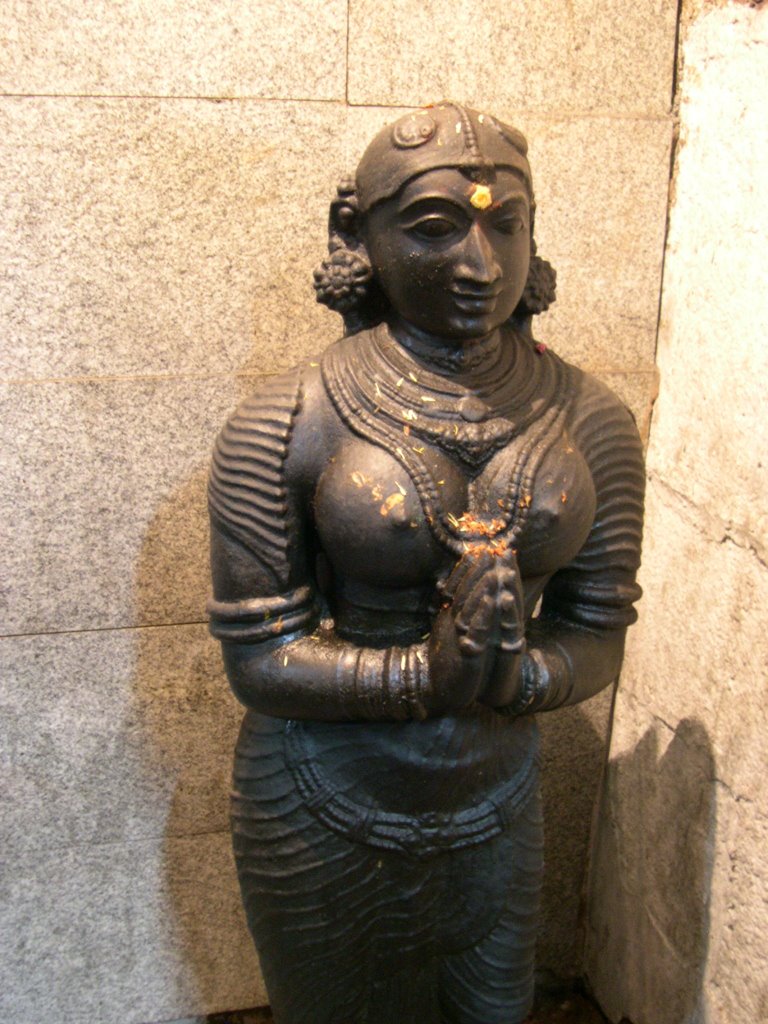
Agni, Pattiswaram Temple

Agni, in current worship in the Pattiswaram temple, Kumbakonam district, S. India Posted by Picasa

Friday, April 14, 2006

Monday, January 23, 2006

Sarasvatam

Today I discovered Somadeva Vasudeva's blog, http://sarasvatam.blogspot.com/
and that inspired me finally to set up my own blog. However, I'm far from sure that I'll use it.

Hello World!


Hello World!